What Is Offpage SEO? The Secret to Higher Google Rankings in 2026
If you’ve ever wondered what is offpage SEO, you’re not alone. Many website owners focus only on optimizing their website pages while ignoring the activities that happen outside their website. The truth is that even the best-written content may struggle to rank if your website lacks authority, credibility, and trust in Google’s eyes. That’s exactly where off-page SEO comes into play.
If you’re a blogger, small business owner, digital marketer, or entrepreneur in the United States, learning about off-page SEO can help you build a stronger online presence, attract more organic traffic, and compete with larger competitors. On-page optimization is the foundation, but off-page SEO is the ignition that shoots your website up the search engine rankings.
In this comprehensive guide, you’ll learn how off-page SEO works, why it’s important, the best strategies you should focus on in 2026, and the common mistakes you should avoid. By the end of this guide, you’ll have a practical roadmap for building authority that lasts.
What Is Offpage SEO?
Offpage SEO is the process of improving a website’s authority, trustworthiness, and search engine visibility through activities performed outside the website itself. These activities include earning high-quality backlinks, building brand mentions, digital PR, local citations, and developing a strong online reputation. Unlike on-page SEO, which focuses on optimizing individual pages, off-page SEO helps search engines determine how credible and influential your website is within its industry. Simply put, off-page SEO is about building your website’s reputation across the internet so that search engines recognize it as a trusted and authoritative source of information.
Think of it this way:
If your website is applying for a job, then your content is your resume, while off-page SEO is the collection of recommendations from respected professionals. The more trusted websites that mention or recommend your website, the more confidence search engines gain in your content.
Off-page SEO includes many different activities, including:
- Building quality backlinks
- Brand mentions
- Digital PR
- Guest posting
- Social media promotion
- Local citations
- Business directory listings
- Influencer collaborations
- Community engagement
- Online reputation management
Together, these signals help search engines understand that your website provides genuine value to users.
Why Is Offpage SEO Important
Search engines don’t simply rank websites because they publish content regularly. They also evaluate whether a website has earned trust across the internet.
Imagine two websites publishing nearly identical articles. Website A has never been mentioned anywhere online. Website B has earned backlinks from respected industry blogs, has active brand mentions, and is regularly referenced by experts. Which website appears more trustworthy? This highlights the importance of off-page SEO, as search engines use these trust signals to determine which websites deserve higher rankings.
In most situations, search engines are more likely to favor Website B because it has stronger authority signals. That’s why off-page SEO remains one of the most important ranking factors.
Some of the biggest benefits include:
- Higher Google rankings
- Increased organic traffic
- Better domain authority
- More referral visitors
- Stronger brand recognition
- Increased trust among potential customers
- Long-term SEO growth
Instead of relying only on technical optimization, off-page SEO helps establish your website as a credible resource within your industry.
On-page vs. Off-page SEO: What’s the Difference?
Many beginners confuse these two concepts because they work together.
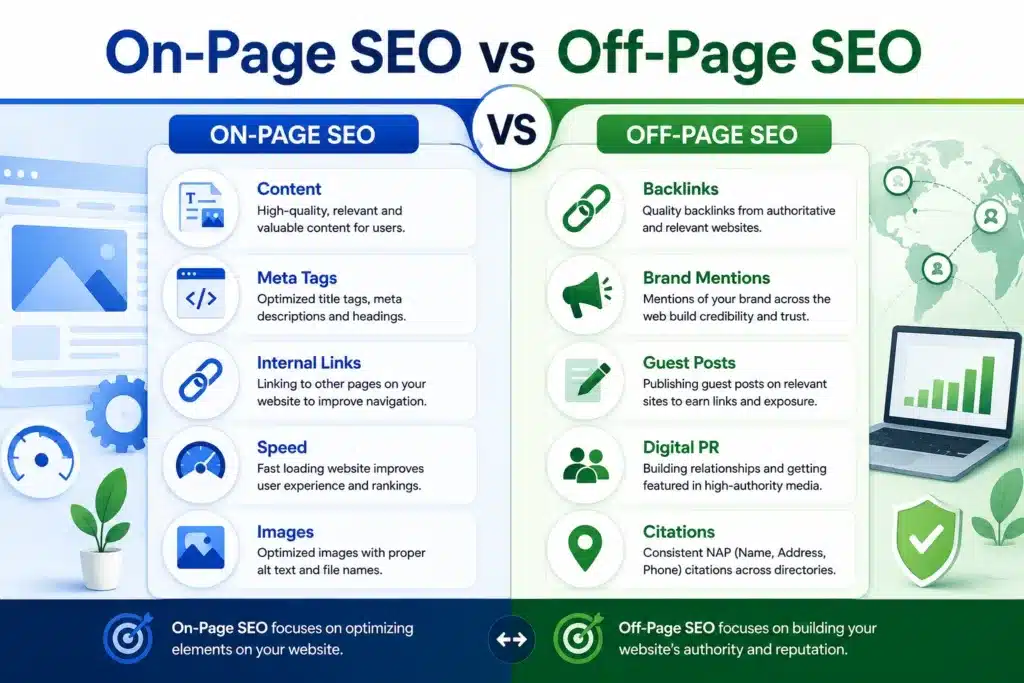
When discussing onpage vs offpage SEO, the easiest way to understand the difference is to think about control.
On-page SEO includes everything you can directly control on your website.
Examples include:
- Optimizing headings
- Writing valuable content
- Internal linking
- Improving page speed
- Image optimization
- Meta descriptions
- Keyword placement
Off-page SEO, however, involves building authority beyond your website.
Examples include:
- Earning backlinks
- Guest blogging
- PR campaigns
- Social media visibility
- Brand mentions
- Local citations
A successful SEO strategy requires both.
Imagine building a beautiful house. On-page SEO builds the house itself, while off-page SEO builds the neighborhood’s trust in that house.
Ignoring either one limits your growth potential.
If you’re still learning SEO fundamentals, you may also enjoy our complete guide, SEO Beginners: How to Rank Higher, Get Organic Traffic & Build Free Backlinks in 2026, where you’ll learn how all the major SEO components work together to create a long-term ranking strategy.
How Does Offpage SEO Work?
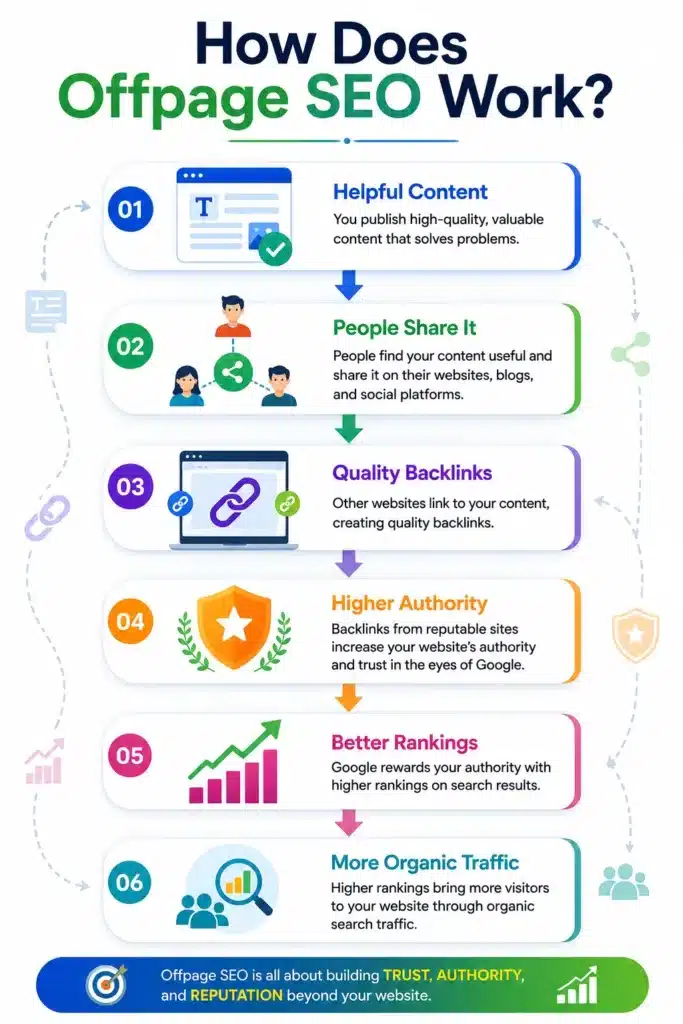
Search engines evaluate hundreds of ranking signals when deciding which pages deserve higher positions in search results, but one factor remains consistently important: website authority. Every time a reputable website links to your content, mentions your brand, or references your expertise, it sends positive trust signals that help search engines evaluate your credibility. Understanding how off-page SEO works is essential because these signals influence how trustworthy your website appears within its industry.
However, not every backlink carries the same value. A single link from an authoritative and relevant website can provide far more SEO value than dozens of links from low-quality or unrelated websites. This is why building a healthy backlink profile is more important than simply increasing the number of links pointing to your site.
Modern off-page SEO focuses on earning high-quality, relevant links rather than chasing quantity. Successful websites prioritize backlinks that are:
- Relevant
- Trustworthy
- Contextual
- Editorially placed
- Natural
By consistently earning quality links and strengthening your online reputation, you build long-term authority that supports sustainable organic growth instead of short-term ranking gains.
The Most Important Offpage SEO Ranking Factors
Although Google evaluates many signals, some carry much greater weight than others.
High-Quality Backlinks
Quality inbound links remain one of the strongest ranking signals in SEO. A backlink is simply another website linking to one of your pages, and each quality link acts as a vote of confidence in your content. However, quality always matters far more than quantity. Building a healthy backlink profile with links from relevant and authoritative websites sends stronger trust signals to search engines than acquiring hundreds of low-quality links.
Strong backlinks usually come from websites that:
- Publish helpful content
- Have established authority
- Are relevant to your niche
- Receive consistent organic traffic
- Maintain editorial standards
One high-quality link from an authoritative website is often worth far more than dozens of low-quality links.
Brand Authority
Google increasingly recognizes brands rather than just websites. If people search for your business, mention your company online, discuss your articles, or reference your expertise, these signals contribute to stronger brand authority.
Growing your reputation across multiple platforms supports long-term SEO success.
Content Sharing
Although social media shares aren’t direct ranking factors, they significantly increase content visibility. The more people discover your content, the greater the chances of earning natural backlinks.
This creates a positive cycle: Better content → More visibility → More backlinks → Better rankings.
Digital PR
Modern SEO has evolved beyond traditional link building.Many businesses now invest in digital public relations by creating the following:
- Industry reports
- Original guides
- Expert interviews
- Case studies
- Infographics
- Research-based content
These resources naturally attract citations from journalists, bloggers, and publishers.
Types of Backlinks You Should Know
Not all backlinks provide the same SEO value. Search engines evaluate backlinks based on their quality, relevance, placement, and the authority of the linking website. Understanding the different types of backlinks can help you focus your efforts on strategies that genuinely strengthen your off-page SEO rather than wasting time on low-value links.
Editorial Backlinks
Editorial backlinks are considered the most valuable type of backlink because they are earned naturally. These links are given by other websites when they find your content informative, trustworthy, or worth referencing. Since they are not requested or paid for, search engines treat them as strong signals of authority.
Guest Post Backlinks
Guest post backlinks are earned by publishing valuable content on relevant websites within your industry. When done ethically, guest posting helps you reach a wider audience, establish credibility, and earn high-quality backlinks from authoritative sources. Focus on contributing helpful content rather than writing solely for link-building purposes.
Business Directory Backlinks
Submitting your website to reputable business directories can help improve your online visibility, especially for local SEO. These backlinks also strengthen your business’s credibility by keeping your company information consistent across trusted platforms. Always choose high-quality directories that are relevant to your industry or location.
Profile Backlinks
Many professional platforms, business communities, and industry websites allow users to create profiles that include a website link. While profile backlinks are generally not as powerful as editorial links, they help diversify your backlink profile and contribute to your overall online presence when built on reputable websites.
Forum Backlinks
Participating in niche-related forums and online communities allows you to share your expertise while naturally referencing your website when it genuinely helps answer a question. Avoid spammy promotion and focus on providing valuable insights, as quality participation builds both trust and referral traffic.
Social Mentions
Although most social media links are nofollow, sharing your content across platforms can significantly increase its visibility. Greater exposure often leads to more people discovering, sharing, and naturally linking to your content. In this way, social mentions indirectly support your off-page SEO by creating opportunities for high-quality backlinks.
Real-World Offpage SEO Case Studies
Real-World Offpage SEO Success Story: Ranking Five UK Websites
When I started working as an SEO Executive, one of my first responsibilities was managing five UK-based websites. My manager’s goal was straightforward: improve their search rankings through consistent off-page SEO.
Instead of chasing hundreds of external links, we followed a structured strategy. On average, I built around six carefully selected backlinks per website each working day.. This included one guest post, one forum thread, and the remaining links came from carefully selected business listings and profile creation websites. Consistency was the key—we followed this routine every working day without skipping, except on Sundays.
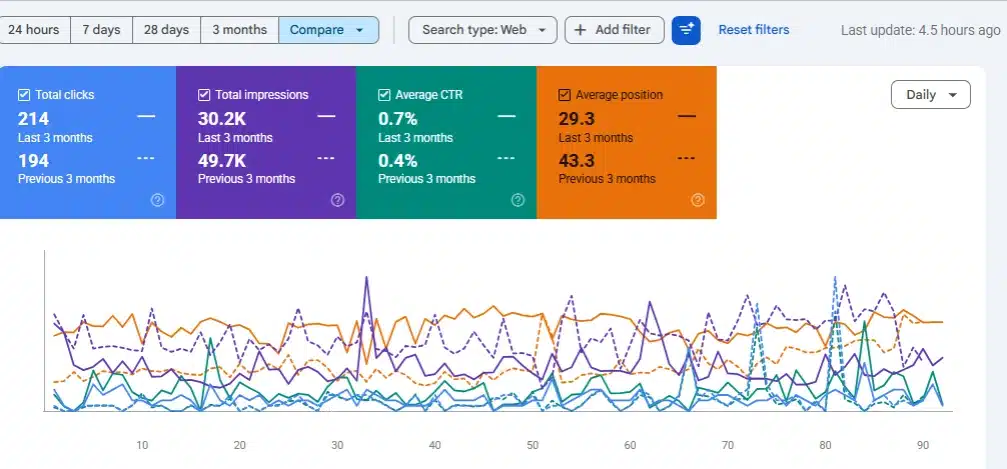
Every Monday, I reviewed keyword rankings, tracked performance, and adjusted the strategy based on the results. Over time, I could clearly see how the websites were improving.
Alhamdulillah, within four months, all five websites started ranking for their target keywords in the UK.
This experience taught me an important lesson about what is offpage SEO. Off-page SEO isn’t about building the highest number of backlinks overnight. It’s about earning relevant, high-quality links consistently while monitoring your progress and improving your strategy over time.
In my experience, backlinks remain one of the strongest signals that help search engines understand a website’s authority. When combined with valuable content and solid on-page optimization, a consistent backlink strategy can significantly improve your chances of ranking higher in Google.
Key Takeaways
- Quality beats quantity.
- Consistency matters more than speed.
- Monitor rankings every week.
- Build relevant backlinks, not random ones.
- Combine off-page SEO with strong on-page SEO.
Real-World Offpage SEO Success Story: Growing a Saudi B2B Website
One of the most memorable SEO projects I’ve worked on involved a B2B website targeting the Saudi Arabian market. The client wanted to increase qualified organic traffic and improve keyword rankings within Saudi Arabia.
Before building backlinks, I performed a complete SEO audit and quickly discovered that the website’s foundation needed improvement. The site structure was poorly organized, several pages had weak meta titles and meta descriptions, and there wasn’t enough optimized content to target relevant search queries.
My first priority was fixing those on-page issues. I improved the website structure, updated the meta titles and meta descriptions across important pages, and published new blog content based on thorough keyword research. Instead of targeting only high-volume keywords, I focused on relevant search terms with lower competition and strong commercial intent.
Once the website had a stronger foundation, I began implementing a consistent off-page SEO strategy by building three to four high-quality backlinks each day from relevant and trustworthy sources.
The results were encouraging. Within approximately 10 days, one of the newly published blog posts started ranking for its target keyword. As more quality backlinks were earned and additional content was published, the website’s organic traffic grew significantly. A website that had previously attracted fewer than 100 daily visitors began generating around 2,000 organic visitors per day, with a large portion of that traffic coming from highly relevant B2B searches.
This project reinforced an important lesson for me. While what is offpage SEO is often associated with backlinks and authority building, the best results come when off-page SEO supports a well-optimized website. Strong content, proper website structure, optimized meta titles, and high-quality backlinks work together to improve search visibility and long-term organic growth.
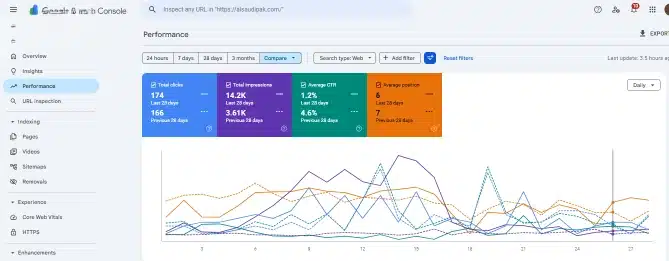
This project demonstrated that combining strong on-page SEO with consistent off-page SEO can significantly improve organic visibility in a competitive B2B market.
Best Offpage SEO Strategies for 2026
Every successful off-page SEO strategy focuses on creating value first and earning trust naturally over time.
Publish Link-Worthy Content
The foundation of successful off-page SEO is creating content people genuinely want to reference.
Ask yourself: Would someone naturally link to this article? If the answer is yes, you’re already ahead of many competitors.
Content that often attracts backlinks includes:
- Ultimate guides
- Tutorials
- Original research
- Free templates
- Checklists
- Statistics roundups
- Helpful tools
The better your content solves a problem, the easier it becomes to earn natural links.
Guest Posting on Relevant Websites
Consistently publishing valuable guest posts is one of the most effective ways to improve off-page SEO while building relationships within your industry.
Instead of submitting articles everywhere, focus on websites that:
- Cover similar topics
- Maintain quality standards
- Serve your target audience
- Have a genuine readership
Quality guest posts build both authority and referral traffic.
Build Relationships Instead of Just Links
Many beginners send hundreds of outreach emails asking for backlinks. A smarter approach is building genuine relationships within your industry.
Connect with:
- Bloggers
- Journalists
- Business owners
- Industry experts
- Podcast hosts
- Content creators
Strong relationships often lead to natural mentions and backlink opportunities without aggressive outreach.
Leverage Local SEO Opportunities
For businesses serving customers in the United States, local citations remain incredibly valuable. Ensure your business information stays consistent across reputable directories. Consistency in your business name, address, and phone number helps strengthen your local online presence while improving trust signals.
Encourage Natural Brand Mentions
Not every authority signal requires a backlink. Mentions of your business across blogs, podcasts, interviews, online communities, and industry discussions can contribute to your overall digital reputation. Building a recognizable brand often leads to stronger long-term SEO performance.
Offpage SEO Tools That Make Your Work Easier
Off-page SEO is no longer just about finding backlink opportunities. Today’s SEO professionals also spend a significant amount of time creating guest posts, outreach emails, content briefs, and resource pages that naturally attract links. Using the right offpage seo tools can make these tasks more efficient while helping you maintain consistency across your campaigns.
For example, keyword research platforms can help you discover backlink opportunities, while content creation tools simplify the process of producing high-quality articles that other websites are more likely to reference. If you’re looking to speed up your writing workflow, our Free Ai Writing Tool can help you generate content ideas, outlines, outreach emails, and SEO-friendly drafts. Instead of replacing human creativity, it acts as a productivity assistant, allowing you to focus on creating original content that supports your long-term off-page SEO strategy.
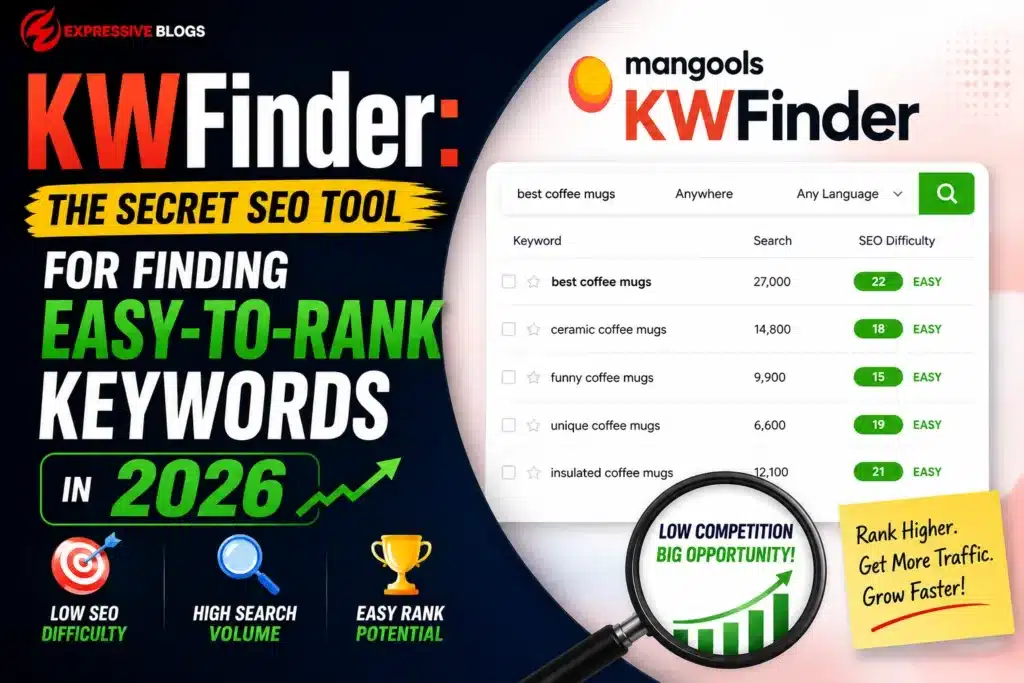
If you’re still researching low-competition keywords before starting your link-building campaign, don’t miss our guide on KWFinder: The Secret SEO Tool for Finding Easy-to-Rank Keywords in 2026, where we explain how to identify valuable keyword opportunities before creating content.
White Hat vs Black Hat Off-Page SEO
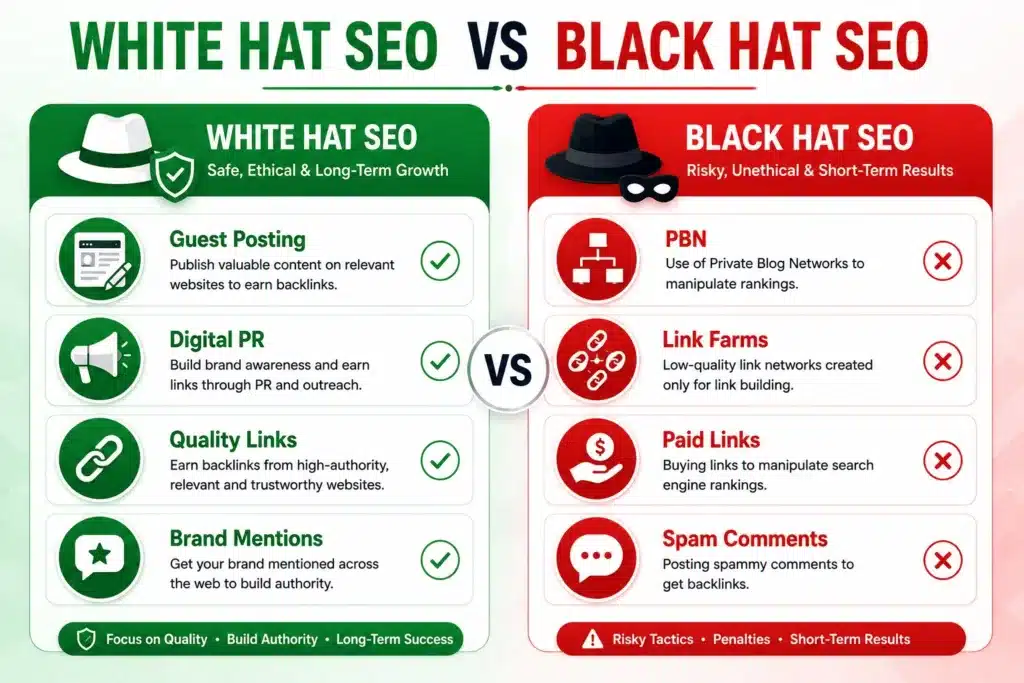
Not every off-page SEO strategy follows search engine guidelines. While some techniques build sustainable authority over time, others attempt to manipulate rankings through shortcuts. Understanding the difference can help you avoid penalties and protect your website’s long-term performance.
White Hat Off-Page SEO
White Hat SEO focuses on ethical practices that provide value to users and earn trust naturally. These methods may take longer to produce results, but they build lasting authority and reduce the risk of search engine penalties.
Search engines continue to improve how they evaluate website quality, authority, and trust. If you want to better understand how Google evaluates websites and SEO best practices, you can explore the official Google Search Central documentation.
Examples include:
- Publishing valuable guest posts on relevant websites
- Earning editorial backlinks through high-quality content
- Building relationships with industry professionals
- Creating shareable resources, guides, and tools
- Encouraging genuine brand mentions
Black Hat Off-Page SEO
Black Hat SEO attempts to manipulate search rankings using tactics that violate search engine guidelines. While these methods may deliver short-term improvements, they often result in ranking drops or manual penalties. To build sustainable rankings, it’s always better to follow Google’s Spam Policies, which explain the practices that can negatively affect your website’s visibility. By focusing on ethical SEO techniques, you can achieve long-term growth without risking search engine penalties.
Avoid practices such as the following:
- Buying backlinks in bulk
- Using private blog networks (PBNs)
- Automated link-building software
- Spam comments on blogs and forums
- Excessive link exchanges
If your goal is long-term growth, always prioritize quality over shortcuts.
Common Off-Page SEO Mistakes to Avoid
Many website owners invest time in link building but unknowingly make mistakes that limit their results. Avoiding these common issues can save you months of wasted effort.
Focusing on Quantity Instead of Quality
A handful of relevant, authoritative backlinks can provide more value than hundreds of low-quality links. Always prioritize websites that are trustworthy and relevant to your niche.
Ignoring On-Page SEO
Off-page SEO cannot compensate for poor website structure or thin content. Before building backlinks, ensure your pages are optimized and provide genuine value to users.
Using the Same Anchor Text Repeatedly
Overusing your target keyword in anchor text can appear unnatural. A healthy backlink profile includes branded, generic, and partial-match anchor texts.
Expecting Instant Results
Authority takes time to build. Off-page SEO is a long-term strategy, and consistent effort typically delivers better results than aggressive short-term campaigns.
How to Measure the Success of Your Off-Page SEO
Building backlinks is only part of the process. To understand whether your strategy is working, monitor key performance indicators over time.
Track metrics such as:
- Growth in referring domains
- Quality of new backlinks
- Organic traffic trends
- Keyword ranking improvements
- Brand mentions
- Referral traffic from external websites
- Conversion rates from organic visitors
Reviewing these metrics regularly helps you refine your strategy and identify new growth opportunities.
Conclusion
Think of off-page SEO as the process of building your website’s reputation and authority across the web rather than simply earning links. Every quality backlink, brand mention, guest post, and digital PR opportunity strengthens your website authority and helps improve long-term organic visibility. While the benefits of off-page SEO don’t appear overnight, consistent effort creates sustainable organic growth and lasting search performance. By combining valuable content, strong on-page optimization, and an ethical off-page SEO strategy, you’ll be in a much stronger position to compete for competitive keywords and achieve long-term success in search results.