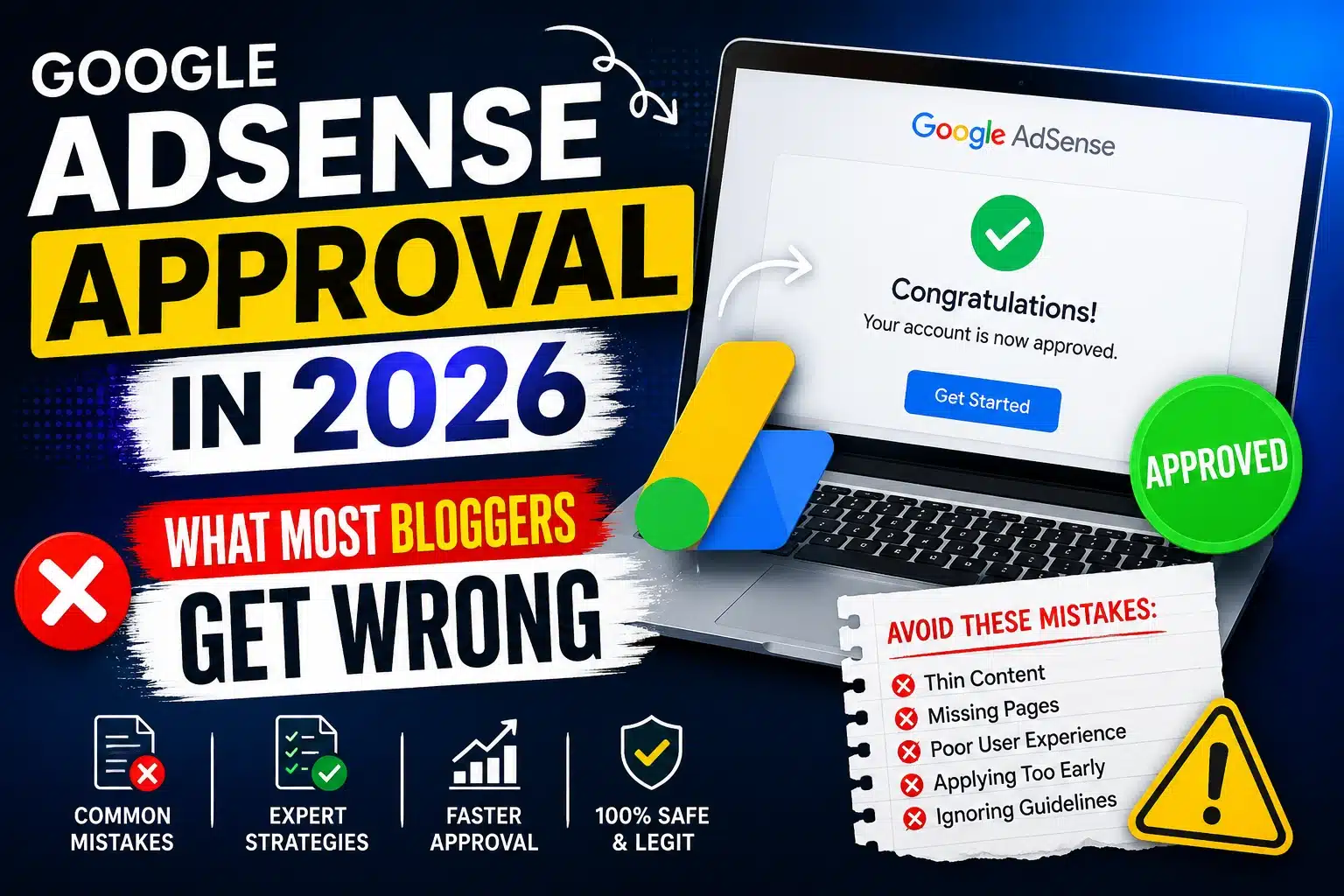
Google AdSense Approval in 2026: What Most Bloggers Get Wrong
Every blogger dreams of earning money from their website, but that excitement often turns into frustration after receiving a Google AdSense rejection email. Many people believe that Google AdSense Approval is only possible for old websites with thousands of visitors, while others waste months chasing secret tricks and shortcuts that never work.
The truth is much simpler. Google doesn’t approve websites because they are old or popular—it approves websites that provide genuine value, maintain a professional structure, and offer an excellent user experience. If your blog solves real problems, publishes original content, and follows Google’s publisher guidelines, you’re already building the foundation for fast Google AdSense approval.
In this guide, you’ll discover the proven strategies that actually work in 2026, the common mistakes that lead to rejection, and the practical steps you can follow to maximize your chances of getting approved on your first attempt.
If you’re new to blogging, understanding how websites grow before monetization is equally important. Before focusing on ads, learn how successful blogs attract traffic and build authority by reading our detailed guide, “What Is Blogging? The Beginner’s Blueprint to Traffic, Influence, and Income in 2026.” Building a strong foundation today will make monetization much easier tomorrow.
Whether you’re launching your first website or applying after multiple rejections, this guide will show you exactly how to get Google AdSense approval fast in 2026 without shortcuts or risky techniques.
Why Most Websites Get Rejected
One of the biggest misconceptions in blogging is that Google approves websites based on the number of articles or monthly visitors.
That’s simply not true. Google reviews your website as a complete product. It evaluates your content quality, user experience, navigation, originality, transparency, and overall trustworthiness.
Imagine you’re an advertiser spending thousands of dollars every month. Would you want your advertisements displayed on a poorly designed website filled with copied articles and broken links? Probably not.
Google thinks the same way.
Most AdSense rejections happen because of a few common mistakes:
- Publishing thin or generic articles
- Missing important pages like Privacy Policy or Contact
- Slow loading speed
- Poor mobile experience
- Unclear website structure
- Duplicate or AI-spammed content
- Applying too early
The good news is that every one of these problems can be fixed before submitting your application.
Understanding Google’s Expectations
Instead of asking, “How many articles do I need?”
Ask yourself a better question: “Would I trust this website if I discovered it on Google?” That’s exactly what Google’s reviewers are looking for.
An AdSense-ready website should have:
- Original content
- Helpful information
- Easy navigation
- Fast loading pages
- Professional design
- Transparent business information
- Regular updates
Rather than creating fifty average articles, focus on twenty comprehensive resources that genuinely help readers. Quality always wins.
Build Content for People, Not Algorithms
Many beginners make the mistake of writing only for search engines. They repeat keywords in every paragraph, copy competitor articles, and publish content that offers nothing new. Google has become much smarter. It rewards websites that demonstrate experience and expertise. Instead of writing another generic article about blogging, share practical insights, explain common mistakes, and provide actionable solutions based on real knowledge. This creates trust with readers and increases the chances of long-term rankings.
Creating high-quality articles consistently can feel overwhelming, especially when you’re managing research, outlines, and SEO optimization at the same time. That’s where our Free AI Writing Tool can simplify the process. It helps generate structured outlines, SEO-friendly titles, meta descriptions, and content ideas while allowing you to maintain complete control over the final writing. Think of it as a productivity assistant rather than a replacement for your creativity.
Website Structure Matters More Than You Think
Many bloggers spend hours writing content but ignore the website itself. Unfortunately, Google doesn’t. Your website should feel organized and easy to navigate.
Visitors should instantly understand:
- What your website is about
- Where they can find information
- How they can contact you
- Why they should trust your content
A clean navigation menu, readable typography, responsive design, and logical categories create a better experience for both readers and search engines. Even excellent content can struggle if visitors find the website confusing.
Case Study: A Beginner Blogger Who Got Approved on the First Attempt
A new blogger named Sami decided to launch a website focused entirely on digital marketing and blogging tutorials. Instead of rushing to monetize, he spent two months building authority. Every week he published three detailed articles based on personal research and practical knowledge. Each article exceeded 1,500 words, included internal links, answered real questions, and followed a simple structure that readers could easily understand.
Before applying for Google AdSense, he also created:
- About Us page
- Contact page
- Privacy Policy
- Disclaimer
- Terms & Conditions
He verified the website in Google Search Console, improved loading speed, and fixed every mobile usability issue. By the end of eight weeks, the website contained twenty-four original articles and was already receiving consistent organic traffic.
When the AdSense application was submitted, approval arrived without any rejection or additional review. The biggest lesson from this story isn’t the number of articles or the age of the domain. It’s the commitment to creating a website that genuinely deserves approval.
Essential Pages You Should Never Skip
Every professional website should include a few pages that build trust and transparency.
About Us
Tell readers who you are, why you started the website, and what they can expect from your content.
Contact Page
Provide a working email address or contact form so visitors and businesses can reach you.
Privacy Policy
Explain how cookies and visitor information are handled.
Disclaimer
If your website shares educational, financial, or informational advice, a disclaimer helps clarify the purpose of your content.
Terms & Conditions
Although many bloggers ignore this page, it strengthens credibility and demonstrates professionalism.
Focus on Long-Term Success
The bloggers who earn consistent AdSense revenue rarely chase shortcuts. They focus on publishing valuable content, improving user experience, and building trust over time. Approval is simply a byproduct of creating a high-quality website.
Instead of asking, “How can I trick Google into approving my website?” Ask yourself, “How can I create a website that Google would confidently recommend to millions of users?” Once you adopt that mindset, AdSense approval becomes significantly easier
The Google AdSense Approval Strategy That Actually Works
One of the biggest mistakes new bloggers make is applying for Google AdSense as soon as they publish ten or fifteen articles. While there’s nothing wrong with being excited about monetization, rushing the process often leads to rejection.
Instead of asking, “When should I apply?” ask yourself, “Is my website ready to represent Google’s advertisers?” That’s the mindset that separates successful publishers from those who keep receiving rejection emails.
Before submitting your application, spend time improving your website every single week. Update old articles, fix broken links, optimize images, and publish fresh content consistently. Google loves websites that are active and maintained rather than abandoned after a few posts.
Consistency beats quantity every time.
Many bloggers believe they need 100 articles before applying for AdSense. That’s simply a myth. A website with twenty-five detailed, helpful articles will almost always outperform another website with one hundred thin, low-quality posts.
Each article should solve a real problem. Instead of writing fifty different articles about the same topic, create comprehensive guides that readers actually bookmark and share. Every blog post should answer questions, provide actionable solutions, and leave visitors feeling satisfied. When users spend more time on your website, browse multiple pages, and return again, Google sees positive quality signals.
Case Study: From Rejection to Approval
Sarah started a personal finance blog with high expectations. She published twelve short articles, installed a free theme, and immediately applied for Google AdSense. Three days later, her application was rejected. Instead of blaming Google, she reviewed her website honestly.
She noticed several issues:
- Articles were only 500–700 words.
- The About page contained just three sentences.
- There was no Disclaimer or Terms page.
- Images were unoptimized.
- Navigation looked confusing on mobile devices.
Over the next six weeks, Sarah completely transformed her website. She expanded every article into detailed guides, improved the website speed, created professional policy pages, and organized her categories properly. She also updated old content instead of only publishing new articles. When she applied again, Google approved her website within a short period.
The lesson is simple: AdSense rejection isn’t the end of the journey. It’s often a roadmap showing you what needs improvement.
Google Search Console Is Your Best Friend
Many bloggers install WordPress, publish articles, and wait for traffic. Professional bloggers don’t. They monitor everything.
Google Search Console allows you to see:
- Which pages are indexed
- Which keywords generate impressions
- Mobile usability issues
- Crawl errors
- Internal linking opportunities
Before applying for AdSense, make sure there are no major indexing or technical problems. A healthy website sends stronger trust signals to Google.
Track Your Growth with Analytics
Numbers tell stories. Even if your website receives only a few visitors every day, understanding their behavior helps improve your content.
Questions you should ask regularly:
- Which article receives the most traffic?
- Which pages have the highest bounce rate?
- How long do visitors stay?
- Which content generates the most engagement?
Improving existing content is often more effective than publishing ten new average articles.
Build Topic Authority Instead of Random Articles
Google prefers websites that specialize in one area. If your blog is about blogging and SEO, keep building around those topics. Create clusters that naturally connect with each other.
For example:
Blogging Cluster
- What Is Blogging? The Beginner’s Blueprint to Traffic, Influence, and Income in 2026
- How to Start a Blog in 2026
- Common Blogging Mistakes Beginners Make
- How Bloggers Earn Money
- How to Get Google AdSense Approval Fast in 2026
This structure helps search engines understand your expertise while encouraging visitors to explore multiple pages. Instead of leaving your website after reading one article, they’ll continue learning from related content, increasing engagement and reducing bounce rate.
Create Better Content Faster
Writing consistently is challenging. Research, outlines, SEO optimization, and editing require time. That’s why many successful bloggers use productivity tools instead of starting every article from scratch.
Our Free AI Writing Tool helps generate content ideas, blog outlines, SEO-friendly titles, meta descriptions, and structured drafts that speed up the writing process while allowing you to maintain complete creative control. Think of it as a brainstorming assistant that helps you publish better content more consistently rather than replacing your expertise.
Internal Linking Improves More Than SEO
Many underestimate internal links. They don’t just help Google crawl your website—they help readers discover valuable content. For example, if someone is reading this guide but is completely new to blogging, the best next step is learning the fundamentals first. That’s why we recommend reading “What Is Blogging? The Beginner’s Blueprint to Traffic, Influence, and Income in 2026.“
It explains how blogs grow, attract visitors, and generate long-term income, creating the perfect foundation before focusing on AdSense monetization. A visitor who reads multiple articles is more likely to trust your website, subscribe to your updates, and return in the future. Google notices these engagement signals too.
Common Mistakes That Delay AdSense Approval
Thousands of bloggers repeat the same mistakes every year. Avoid these common issues:
- Publishing AI-generated content without editing
- Copying competitor articles
- Applying with an incomplete website
- Ignoring mobile optimization
- Using slow themes with unnecessary plugins
- Missing About, Contact, or Privacy Policy pages
- Writing on ten unrelated topics without a clear niche
- Stuffing keywords into every paragraph
Remember, Google wants websites that genuinely help users—not websites created only to display advertisements.
Think Like a Publisher, Not Just a Blogger
The most successful AdSense publishers don’t spend their time worrying about approval emails—they focus on building a website that people genuinely trust and enjoy. Every high-quality article they publish strengthens their authority, every update improves the user experience, and every well-placed internal link helps visitors discover more valuable content. By consistently creating original, helpful, and SEO-friendly resources, bloggers naturally increase their credibility with both readers and search engines. When your website prioritizes value over shortcuts, AdSense approval becomes a natural milestone rather than a difficult challenge, setting the foundation for long-term traffic, higher engagement, and sustainable online income.
Case Study: How a Focused Blog Earned Google AdSense Approval Without Massive Traffic
One of the biggest myths in the blogging community is that you need thousands of monthly visitors before applying for Google AdSense. In reality, quality always outweighs quantity. Consider the example of a blogger who launched a website dedicated entirely to blogging and SEO tutorials. Instead of covering random topics like health, finance, travel, and technology, every article was written around a single niche.
During the first three months, the website published only twenty-two articles, but each one exceeded 1,800 words and solved a specific problem. The blogger regularly updated older posts, improved internal linking, optimized images, and maintained a fast-loading website. Traffic wasn’t extraordinary—just a few hundred organic visitors every month—but those visitors stayed longer, explored multiple pages, and engaged with the content. The website also included a professional About page, Contact page, Privacy Policy, Disclaimer, and Terms & Conditions page. When the AdSense application was submitted, approval arrived without any issues.
The lesson is simple: Google doesn’t reward websites that publish the most content. It rewards websites that publish the best content.
Your Complete AdSense Approval Checklist
Before clicking the Apply button, go through this checklist carefully.
Content
- 20–30 original blog posts
- Every article provides genuine value
- No duplicate or copied content
- Proper headings and formatting
- Internal linking implemented
Website
- Mobile-friendly design
- Fast loading speed
- SSL certificate installed
- Clean navigation
- No broken links
Essential Pages
- About Us
- Contact
- Privacy Policy
- Disclaimer
- Terms & Conditions
Technical SEO
- Google Search Console connected
- XML Sitemap submitted
- robots.txt configured Indexed pages checked
User Experience
- Easy navigation
- Readable typography
- Optimized images
- Minimal popups
- Professional layout
If every item is checked, your website is already ahead of thousands of other AdSense applications.
Best Niches That Perform Well With AdSense
Although Google approves websites from almost every niche, some categories naturally perform better because they consistently provide informational value.
Popular examples include:
- Blogging and SEO
- Technology
- Digital Marketing
- Education
- Software Tutorials
- Business Guides
- Productivity
- Travel
- Food
- Home Improvement
- Freelancing
Instead of chasing trends, choose a niche that you genuinely enjoy writing about. Consistency becomes much easier when you’re interested in the topic.
What Happens After You Apply for Google AdSense?
Once you’ve submitted your application, the next step is monitoring its progress through your Google AdSense Login account. From your dashboard, you can check your review status, respond to policy notifications, and complete any verification steps if required. After approval, the same account becomes your control center for creating ad units, enabling Auto Ads, tracking earnings, and managing payments. Regularly accessing your Google AdSense account ensures that your website stays compliant with Google’s policies while helping you maximize your advertising revenue.
Conclusion
Getting AdSense approval isn’t about finding shortcuts or submitting your application as quickly as possible—it’s about building a website that genuinely deserves to be monetized. The most successful bloggers focus on publishing original, high-quality content, improving site performance, and creating a seamless user experience instead of worrying about rejection emails. Every well-written article strengthens your website’s authority, every update increases its credibility, and every internal link helps visitors discover more valuable information. By consistently following Google AdSense ploicies and prioritizing helpful content over quick earnings, you significantly improve your chances of approval. If you’re wondering how to get AdSense approval fast in 2026, remember that quality, consistency, and trust are the real strategies that lead to long-term success and sustainable blogging income.
Frequently Asked Questions (FAQs)
How long does Google AdSense approval take in 2026?
Google AdSense approval usually takes a few days to a few weeks, depending on your website quality, content originality, and compliance with Google’s publisher guidelines.
How many articles do I need for Google AdSense approval?
There is no fixed number. A website with 20–30 high-quality, original articles is generally better than one with dozens of thin or duplicate posts.
Can I get Google AdSense approval without traffic?
Yes. Google focuses on content quality, website structure, and user experience rather than the number of visitors.
Why does Google AdSense reject websites?
Common reasons include low-quality content, missing essential pages, poor navigation, duplicate content, and policy violations.
Which pages are required for Google AdSense approval?
Every website should have an About Us, Contact, Privacy Policy, Disclaimer, and Terms & Conditions page before applying.
Does domain age matter for Google AdSense approval?
No. Google does not officially require a specific domain age. A well-optimized website with valuable content can get approved regardless of how new it is.
Is AI-generated content allowed for Google AdSense?
AI-assisted content is acceptable if it is original, helpful, accurate, and edited by a human to provide genuine value to readers.
What is the best niche for Google AdSense in 2026?
Blogging, digital marketing, technology, education, finance, and software tutorials are among the most popular AdSense-friendly niches.
How can I increase my chances of Google AdSense approval?
Publish original content, improve website speed, create essential pages, optimize for mobile devices, and follow Google AdSense policies.
Can I reapply after Google AdSense rejection?
Yes. You can fix the issues mentioned in the rejection notice, improve your website, and submit a new application.