

How to Become a Freelance Writer in 2026: Beginner Guide to Getting Paid Clients
If you’re searching for how to become a freelance writer, you’re already one step closer to building a flexible and profitable career. As someone who has worked in SEO, blogging, and content writing for international websites, I’ve seen how skilled freelance writers help businesses grow through high-quality content.
Freelance writing isn’t just about writing articles. Businesses hire writers to create content that attracts readers, builds trust, and supports their marketing goals. Once you understand that, you’ll start thinking beyond words and focus on delivering real value.
If you’re completely new to freelancing, I recommend reading my How to Start Freelancing guide first. It covers the fundamentals of freelancing, finding clients, and building a strong foundation before choosing a niche like freelance writing.
In this guide, you’ll learn how to develop your writing skills, build a portfolio, find clients, set your rates, and grow a successful freelance writing career from scratch.
My Experience
Over the past few years, I’ve worked on SEO content and blogging projects for international businesses across multiple industries. During that time, I’ve learned what clients expect from freelance writers, what helps content perform better on search engines, and the practical skills that turn writing into a valuable business service. This guide is based on those real-world experiences and the lessons I’ve learned while working on client and blogging projects.
Who Should Become a Freelance Writer?
Freelance writing is one of the few careers that welcomes people from almost every background. Whether you’re looking to earn extra income, change careers, or build a location-independent business, freelance writing offers opportunities for anyone willing to learn and improve. If you’re wondering how to become a freelance writer, the good news is that you don’t need years of experience to get started—you simply need the right mindset, consistent practice, and a commitment to delivering value.
Freelance writing can be an excellent career choice for
- Students who want to earn money online while developing valuable communication and research skills.
- Fresh graduates looking to gain practical experience and build a professional portfolio before landing a full-time job.
- Stay-at-home parents who need a flexible career that fits around family responsibilities.
- Full-time employees who want to create an additional income stream or transition into self-employment.
- Bloggers who want to improve their content writing skills and monetize their websites more effectively.
- Digital marketers who want to strengthen their SEO content and copywriting expertise.
- Business owners who want to create compelling content for their websites, attract more customers, and build authority within their industry.
Regardless of your background, freelance writing rewards those who are willing to keep learning, adapt to client needs, and consistently produce high-quality work. With patience and persistence, it can grow from a side hustle into a profitable long-term career.
What Is a Freelance Writer?
A freelance writer is an independent professional who creates written content for businesses, entrepreneurs, agencies, publications, and organizations without being employed full-time by a single company. Unlike traditional employees, freelance writers choose their clients, set their schedules, decide their pricing, and often work remotely from anywhere in the world.
A freelance writer may create the following:
- Blog posts
- Website pages
- Landing pages
- SEO articles
- Product descriptions
- Email newsletters
- Case studies
- Video scripts
- Social media content
- eBooks
- Press releases
Some writers specialize in one service, while others offer several depending on their expertise. As your experience grows, you can expand into copywriting, content strategy, editing, and consulting.
Why Freelance Writing Is One of the Best Online Careers
Freelance writing continues to grow because content has become essential for almost every business. Companies need informative articles, optimized website pages, engaging newsletters, and persuasive marketing copy to compete online. This demand creates opportunities for skilled writers who understand both communication and digital marketing.
Some of the biggest benefits include:
- Work from anywhere.
- Choose your own working hours.
- Build multiple income streams.
- Work with international clients.
- Turn writing into a full-time business.
- Continue increasing your rates as your expertise grows.
Unlike many online businesses, freelance writing requires very little investment to begin. A laptop, an internet connection, and a commitment to improving your skills are enough to get started.
Is Freelance Writing Still Worth It in 2026?
Yes, freelance writing is still a rewarding career in 2026. Although AI tools have made content creation faster and competition has increased, businesses continue to rely on skilled writers who can produce original, engaging, and audience-focused content. AI can assist with research and brainstorming, but it cannot fully replace human creativity, critical thinking, or the ability to understand a brand’s unique voice.
As more businesses invest in content marketing and SEO, the demand for professional writers remains strong. Companies aren’t just looking for someone who can write—they want writers who can educate readers, build trust, and support business growth. If you’re learning how to become a freelance writer, this is still an excellent time to start. By continuously improving your skills, choosing a profitable niche, and delivering high-quality content, you can build a successful freelance writing career despite the growing competition.
Skills Every Freelance Writer Should Develop
Learning how to be a freelance writer involves much more than writing grammatically correct sentences. Clients pay for clear communication, research, problem-solving, and content that delivers results.
The most successful freelance writers continuously improve these skills:
Writing
Your writing should be clear, engaging, and easy to understand. Avoid unnecessary complexity and focus on helping the reader.
Research
Professional writers often write about industries they have never worked in. Strong research skills help you understand new topics quickly while producing original, valuable content.
SEO
Modern businesses want content that can attract organic traffic. Understanding keyword placement, search intent, headings, readability, and internal linking makes you a far more valuable writer.
As your experience grows, don’t limit yourself to writing alone. Exploring other high-income services can help you diversify your income and attract better clients. Our guide on best freelancing skills covers the most in-demand skills that complement freelance writing and can help you build a more profitable freelance business.
Communication
Professional communication builds trust. Respond on time, ask thoughtful questions, clarify expectations, and keep clients informed throughout every project.
Time Management
Freelancers often manage multiple deadlines simultaneously. Creating realistic schedules and delivering work before the deadline helps you build a strong reputation and encourages repeat business.
Choose a Profitable Freelance Writing Niche
One mistake beginners make is trying to write about everything. While this seems like it creates more opportunities, it often makes marketing yourself much harder. Instead, choose an industry where you can gradually become an expert.
Popular freelance writing niches include:
- Technology
- SaaS
- Digital Marketing
- Finance
- Health
- Education
- Real Estate
- eCommerce
- Artificial Intelligence
Specializing allows you to build authority, attract better clients, and charge higher rates because businesses prefer writers who understand their industry rather than generalists.
.
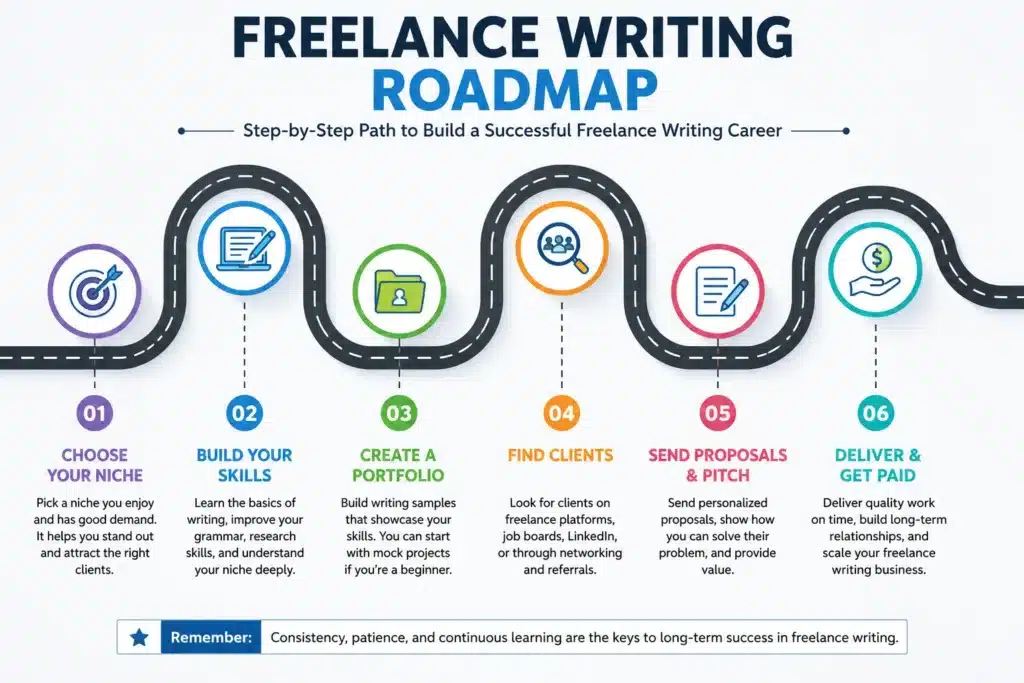
How to Start Freelance Writing: A Step-by-Step Roadmap
Knowing how to become a freelance writer is one thing, but taking the right steps in the correct order is what separates successful writers from those who give up after a few weeks. Many beginners spend months watching tutorials, buying courses, and waiting until they feel “ready.” The truth is that you become a better freelance writer by writing consistently and improving with every project. The roadmap below will help you build a strong foundation without feeling overwhelmed.
Step 1: Learn the Basics Before Looking for Clients
Before sending proposals, understand the fundamentals of professional writing. Focus on writing content that is easy to read, well-structured, and valuable to the reader. Learn how to write compelling introductions, informative body sections, and conclusions that encourage readers to take action.
At the same time, become familiar with basic SEO principles. You don’t need to become an SEO expert overnight, but understanding search intent, keyword placement, headings, readability, and internal linking will make your content much more valuable to clients.
Step 2: Best Freelance Writing Niches for US Clients
Many beginners make the mistake of offering every writing service imaginable. Instead, start with one service and become exceptionally good at it.
You can begin with services such as the following:
- SaaS
- Technology
- Healthcare
- Finance & FinTech
- Digital Marketing
- eCommerce
- Real Estate
- Artificial Intelligence
- Legal
- Cybersecurity
Mastering one service first allows you to build confidence and produce consistently high-quality work.
Step 3: Choose Your Ideal Niche
Selecting a niche helps you position yourself as a specialist instead of a general writer.
Ask yourself:
- Which industries interest me?
- What topics do I enjoy researching?
- Which businesses regularly invest in content marketing?
Choosing a niche doesn’t mean you’re locked into it forever. As your career grows, you can expand into additional industries based on your interests and experience.
Build a Portfolio Even If You Have No Experience
One of the biggest reasons people delay becoming freelance writers is that they think they need previous clients before applying for jobs.
You don’t. Clients don’t pay for experience alone—they pay for quality. Create your own portfolio by writing sample projects that demonstrate your skills.
Examples include:
- A 2,000-word SEO blog post
- A website homepage
- A service page
- A product description
- An email sequence
- A landing page
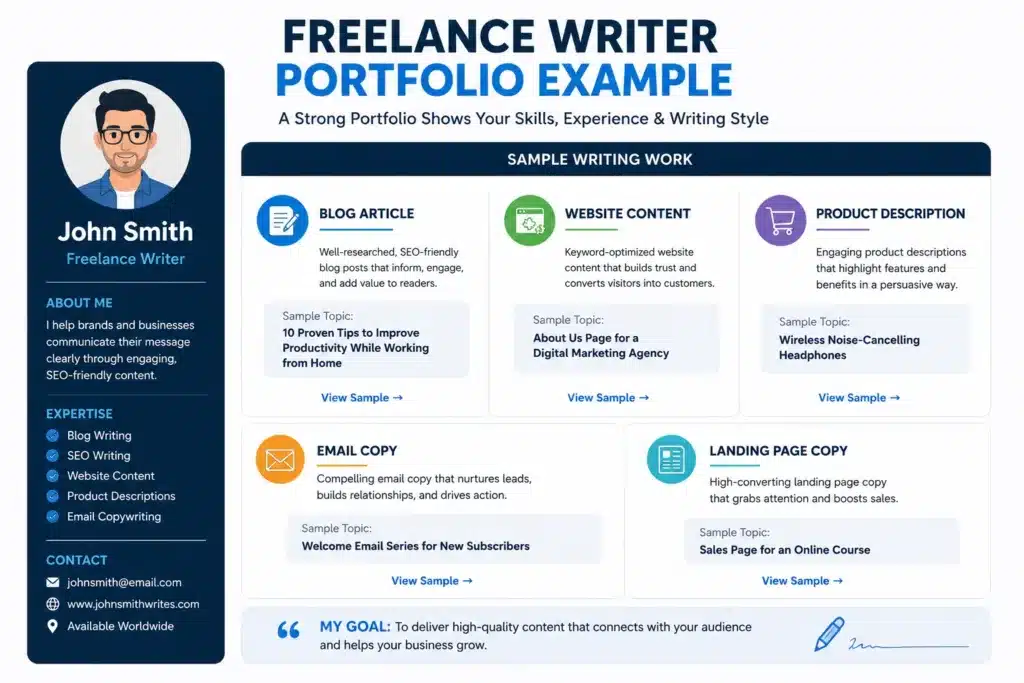
These samples prove your ability even before you’ve completed your first paid project. Instead of creating dozens of average samples, focus on producing five or six outstanding pieces that genuinely showcase your writing.
If you don’t have a personal website yet, our How to Create a Freelance Portfolio guide will help you build a professional portfolio that showcases your skills and attracts potential clients.
Expert insight
One thing I’ve consistently seen in freelance writing portfolios is that quality always makes a stronger impression than quantity. Rather than a bunch of mediocre samples, focus on a handful of well-crafted ones that showcase your writing ability and professionalism.
Example of a Beginner Freelance Writing Portfolio
If you’re wondering what a beginner’s portfolio should look like, here’s a simple example. Suppose you want to write for SaaS companies. Instead of waiting for your first client, create a few high-quality sample projects that showcase your writing skills and understanding of the industry.
Your portfolio could include:
- A detailed SEO blog article explaining a common SaaS challenge.
- A compelling homepage introducing a fictional software company.
- A pricing page highlighting different subscription plans.
- A product description focusing on key features and benefits.
- An email newsletter announcing a new product update or feature release.
These sample projects demonstrate your writing ability, creativity, and understanding of different content formats. A well-organized portfolio like this gives potential clients confidence in your skills, even if you haven’t worked with paying clients yet.
Practical Example
Suppose a SaaS company needs a blog about CRM software. Instead of writing a generic article, a professional freelance writer researches the audience, understands search intent, optimizes the content for SEO, and creates a blog that educates readers while supporting the company’s marketing goals. This is exactly the type of value clients are willing to pay for.
Create Your Personal Brand
Freelance writing is a business, and every successful business needs a recognizable brand.
Start by creating:
- A professional LinkedIn profile
- A simple portfolio website
- A professional email address
- A consistent profile photo
- A short but powerful bio explaining who you help and what you do
Your goal is to make clients feel confident before they even speak with you.
Build a Website That Sells Your Services
Although freelance platforms are useful, having your own website makes you appear far more professional. Your website doesn’t need to be complicated.
It should include:
- Home
- About
- Services
- Portfolio
- Contact
As your experience grows, add a blog where you publish helpful articles related to your niche. This demonstrates expertise while helping potential clients discover you through search engines.
Optimize Your LinkedIn Profile
LinkedIn is one of the most powerful tools for freelance writers because decision-makers use it every day. Your profile should immediately communicate:
- What you do
- Who you help
- What results do you deliver
Instead of writing a generic headline like Freelance Writer, Use something more specific, such as: SEO Freelance Writer Helping Businesses Grow Through High-Quality Content. This immediately tells potential clients what problem you solve.
Publish valuable posts consistently, engage with professionals in your niche, and showcase your writing expertise. Over time, LinkedIn can become one of your strongest client acquisition channels.
Keep improving your skills.
Freelance writing is constantly evolving. Search engine algorithms change, businesses adopt new marketing strategies, and readers expect better content than ever before.
To stay competitive, continue improving your knowledge of writing, SEO, content marketing, communication, and digital tools. By continuously learning and adapting, you’ll not only become a better writer but also build a freelance business that continues to grow year after year.
Industry Observation
One trend that is becoming more and more clear is that businesses are now looking for writers who understand search intent, user experience and content strategy, not just grammar. Writers who continue to learn about SEO and content marketing often have a better competitive advantage than writers who focus on writing alone.
Finding Your First Freelance Writing Clients
Once your portfolio is ready, it’s time to find clients. This is the stage where many beginners lose confidence because they expect results immediately. The reality is that getting your first freelance client requires consistency, patience, and a professional approach. Remember, clients don’t know you yet. Your job is to show them why you’re the right person for their project.
Where Do Freelance Writers Actually Find Clients?
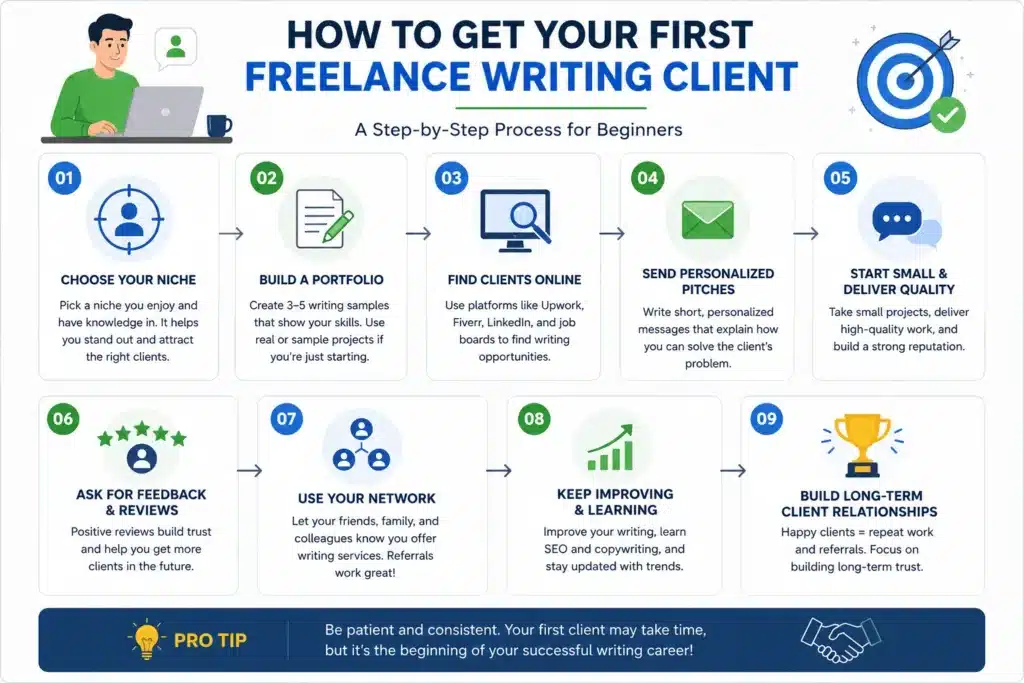
One of the biggest questions beginners ask is where they can find their first freelance writing clients. The good news is that you don’t need to rely on a single source. Successful freelance writers use multiple channels to build a steady flow of opportunities and reduce their dependence on any one platform.
Some of the best places to find freelance writing clients include:
- Freelance Platforms: Websites like Upwork and Fiverr connect writers with businesses actively looking for content services. If you’re unsure where to begin, our guide on Best Freelancing Platforms can help you choose the right platform for your experience level.
- LinkedIn: Build a professional profile, share valuable content, and connect with business owners, marketing managers, and agencies that regularly hire freelance writers.
- Referrals: Happy clients can become your best marketing channel by recommending your services to others.
- Cold Emails: Reach out to businesses with outdated blogs or weak website content and explain how your writing can help them improve their online presence.
- Content Agencies: Many agencies regularly outsource writing projects, making them a great option for beginners looking for consistent work.
- Your Personal Website: A professional portfolio website helps showcase your expertise and allows potential clients to discover your services through search engines.
Instead of depending on just one method, focus on building your presence across multiple channels. This approach increases your chances of finding quality clients and creating a more stable freelance writing business.
Start With Freelance Platforms
Freelance marketplaces are an excellent starting point because businesses are already searching for writers. However, simply creating a profile isn’t enough. Thousands of freelancers compete for the same projects, so your profile must clearly communicate the value you offer.
Instead of describing yourself as someone who can “write articles,” explain how your writing helps businesses attract traffic, educate customers, or increase conversions.
Keep your profile focused on the client’s needs rather than your personal goals.
Write Proposals That Clients Actually Read
Many beginners copy the same proposal for every project. Clients notice this immediately and usually ignore those applications. A winning proposal should be personalized and concise.
Practical Tip
Many beginners send the same proposal to every client and wonder why they get no replies. A short, personalized proposal indicating that you understand the client’s project is usually far more effective than a generic message that has been copied and pasted dozens of times.
Before writing your proposal:
- Read the project description carefully.
- Mention something specific about the client’s requirements.
- Explain how you would approach the project.
- Share one or two relevant writing samples.
- End with a friendly call to discuss the project further.
Clients appreciate freelancers who understand their business instead of sending generic messages.
Use Cold Email to Find Hidden Opportunities
Not every business posts freelance jobs online. Many companies need writers but never advertise openings. This is where cold emailing becomes valuable.
Look for businesses with outdated blogs, poorly written website content, or inactive resource sections. Reach out with a personalized email explaining how consistent, high-quality content could help them attract more visitors and build authority.
Avoid sending mass emails. Instead, write each email specifically for that business. Personalized outreach usually generates much better responses than generic templates.
Leverage LinkedIn for Client Acquisition
LinkedIn is much more than an online résumé. Business owners, startup founders, agency managers, and marketing professionals regularly search for freelance writers there.
To stand out:
- Publish writing-related content consistently.
- Share useful tips about content marketing.
- Comment on posts from people in your target industry.
- Connect with decision-makers instead of random users.
Over time, people begin recognizing your expertise, making it easier for clients to contact you directly.
Ask Every Happy Client for a Testimonial
Your first few testimonials are incredibly valuable. After successfully completing a project, politely ask the client to share a short review about their experience working with you. Testimonials increase trust and make future clients feel more confident hiring you. Display them on your portfolio website, LinkedIn profile, and freelance platform accounts whenever possible.
How to Price Your Freelance Writing Services
One of the biggest mistakes beginners make is charging extremely low rates. Many believe lower prices will help them win more projects. Unfortunately, low prices often attract clients who care only about cost rather than quality. Instead of competing to be the cheapest writer, compete by delivering exceptional value.
Professional Advice
Setting very low prices may help you win your first project, but it can also attract clients who focus only on cost. As your portfolio and confidence grow, gradually increase your rates and position yourself based on the value you provide rather than the lowest price.
| Experience | Suggested Pricing Strategy |
|---|---|
| Beginner | Build a portfolio first and charge reasonable rates |
| Intermediate | Increase project-based pricing |
| Experienced | Value-based pricing and retainers |
Now we will discuss the three most common pricing methods, which are the following:
Per Word
Suitable for blog posts and articles where the content length is clearly defined.
Per Project
Ideal for website copy, landing pages, case studies, and email campaigns because clients know exactly what they will pay.
Hourly Rate
Useful for editing, consulting, strategy sessions, or ongoing content work. As your experience grows, move away from charging solely for words. Clients are paying for your expertise, research, strategic thinking, and ability to produce content that helps their business grow.
Freelance Writing Rates for Beginners in 2026
There isn’t a single “correct” rate for beginner freelance writers. Your pricing depends on your skills, writing niche, project complexity, research requirements, and the value you create for clients. Instead of copying other writers’ prices, build a pricing strategy that grows with your experience.
When you’re starting out, focus on building credibility rather than maximizing income. Complete a few high-quality projects, create a professional portfolio, and collect testimonials from satisfied clients. Once you consistently deliver results, increasing your rates becomes much easier because clients pay for proven expertise, not just words on a page.
Pricing Growth Roadmap
| Experience Level | Primary Focus |
|---|---|
| First 3 Clients | Build trust and portfolio |
| Next 10 Clients | Improve quality and collect testimonials |
| Established Writer | Increase rates based on expertise and results |
Know When It’s Time to Increase Your Rates
Many freelancers continue charging beginner prices even after gaining significant experience.
Consider raising your rates when:
- You’re consistently booked.
- Clients keep returning with new work.
- Your portfolio has improved.
- You specialize in a profitable niche.
- You’re delivering measurable results for clients.
Quality clients understand that experienced professionals charge more because they provide better outcomes.
Deliver Work Like a Professional
Getting clients is only the beginning. Keeping them is where long-term success comes from.
Professional freelance writers:
- Deliver projects before the deadline.
- Follow instructions carefully.
- Proofread every assignment.
- Communicate regularly.
- Accept feedback positively.
- Suggest ideas that improve the project.
These small habits often turn one-time projects into long-term partnerships. Long-term clients provide stable income, reduce the need for constant pitching, and frequently refer new clients to you.
Diversify Your Income
Don’t rely on a single client or one writing service forever. As your experience grows, consider expanding into related services such as:
- SEO content strategy
- Copywriting
- Ghostwriting
- Editing
- Content planning
- Email marketing
You can also explore different freelancing jobs that match your strengths and interests. Expanding your services not only increases your earning potential but also protects your business if demand changes in one particular area.
Use Technology to Improve Productivity
Professional writers focus on producing better work—not just writing faster. Grammar checkers, project management tools, note-taking apps, and AI-powered assistants can help streamline your workflow without replacing your creativity.
If you’re looking for a faster way to brainstorm ideas, overcome writer’s block, or organize content before writing, our Free AI Writing Tool can help speed up your workflow while allowing you to create polished, original content in your own voice.
Practical Observation
AI tools can speed up research, brainstorming, and outlining, but they still require human judgment, editing, and creativity. The most successful freelance writers use AI to improve efficiency while ensuring the final content reflects their own expertise and writing style.
The goal is not to let technology write for you. The goal is to use it wisely so you can spend more time thinking strategically and producing higher-quality work.
Essential Tools Every Freelance Writer Should Use in 2026
Using the right tools can help you write more efficiently, stay organized, and deliver high-quality work to your clients. While your writing skills will always be your greatest asset, these tools can simplify your workflow and save valuable time.
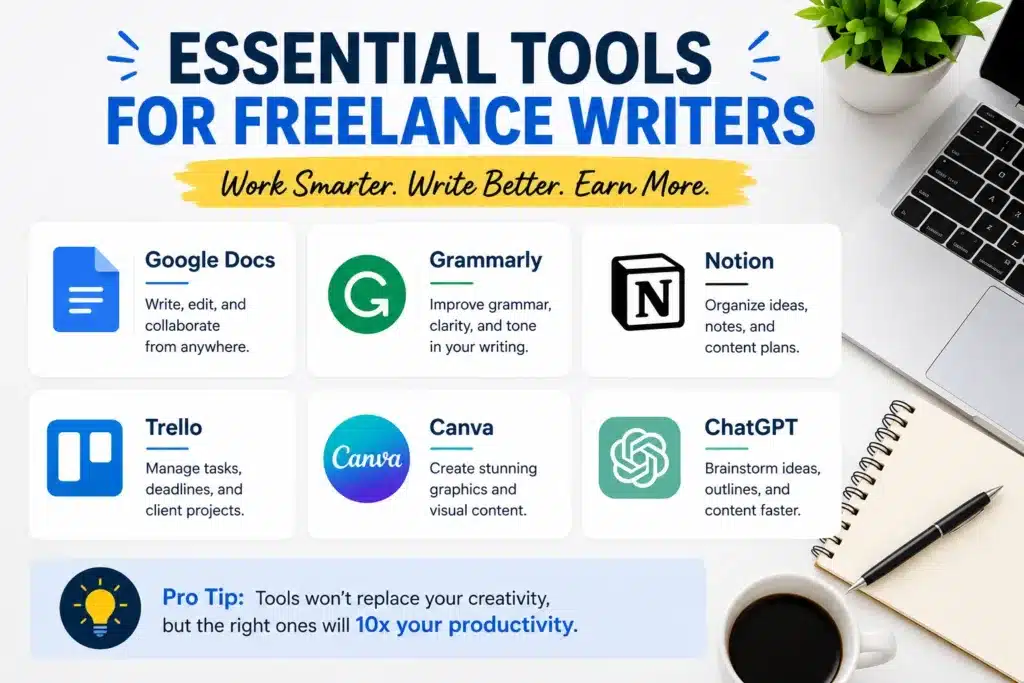
Some useful tools every freelance writer should consider include:
- Google Docs for writing, editing, and collaborating with clients.
- Grammarly to check grammar, spelling, and improve clarity.
- Notion for organizing ideas, research, and content calendars.
- Trello to manage writing projects, deadlines, and client tasks.
- Canva for creating simple graphics, blog banners, and social media visuals.
- AI writing assistants for brainstorming ideas, generating outlines, and overcoming writer’s block.
If you’re looking for a simple way to generate ideas and improve your writing workflow, you can also try our Free AI Writing Tool. It’s designed to help you brainstorm content faster while allowing you to create original, high-quality work in your own voice.
Remember, these tools are meant to support your writing process—not replace your creativity, research, or critical thinking. The most successful freelance writers use technology to work smarter while ensuring every piece of content delivers real value to readers.
Common Mistakes That Stop Freelance Writers from Succeeding
Even talented writers struggle when they repeat the same mistakes. The good news is that most of these problems are completely avoidable once you know what to watch for.
What Makes a Successful Freelance Writer?
Successful freelance writers aren’t successful because they write faster than anybody else. They succeed because they know their audience, communicate professionally, meet deadlines, and continue to improve with every project. Building these habits early on can go a long way in the growth of your freelance career.
Waiting Until You Feel “Ready”
Perfection is one of the biggest enemies of progress. Many aspiring writers spend months watching tutorials, reading blogs, and taking courses without ever pitching a client. While learning is important, experience comes from doing the work.
- Your first article won’t be perfect.
- Your first proposal won’t be perfect.
- Your first client may even reject you.
- That’s completely normal.
Every successful freelance writer started exactly the same way.
Writing Without Understanding the Target Audience
A common beginner mistake is writing for everyone. Professional content is always written for a specific audience.
Before writing, ask yourself:
- Who will read this content?
- What problem are they trying to solve?
- What questions do they have?
- What action should they take after reading?
Answering these questions helps you create content that feels relevant and valuable.
Ignoring SEO
Great writing has little impact if it isn’t discoverable. Understanding basic SEO, including search intent, keywords, headings, and internal linking, helps you create content that readers and search engines can find. If you’re just getting started, check out our SEO for Beginners guide.
Charging Extremely Low Rates
Everyone starts somewhere, but don’t build your entire career around being the cheapest option. Low-paying clients often expect the most work while appreciating it the least.
- Focus on delivering outstanding quality.
- As your portfolio and confidence grow, gradually increase your pricing.
- Quality clients are willing to invest in reliable professionals.
Missing Deadlines
Nothing damages your reputation faster than delivering work late without communication. Always give yourself enough time to research, write, edit, and proofread before submission. If an unexpected issue arises, inform your client immediately rather than waiting until the deadline passes. Professional communication builds trust.
Depending on One Client
Landing your first long-term client feels exciting, but relying on one income source is risky. Clients change priorities. Budgets get reduced. Projects end. Continue networking and marketing yourself even when you’re busy. A healthy freelance business always has multiple client opportunities.
How to Build a Long-Term Freelance Writing Career
Learning how to become a freelance writer is only the beginning. The real goal is building a career that continues growing year after year. The most successful freelance writers focus on long-term improvement instead of short-term income.
They continuously:
- Improve their writing skills.
- Learn new marketing techniques.
- Stay updated with SEO trends.
- Build stronger relationships with clients.
- Invest in their personal brand.
- Publish valuable content.
- Expand into higher-paying niches.
Consistency matters more than speed.
Writing one excellent article every week for a year will improve your skills far more than writing dozens of rushed articles in a single month.
Your 30-Day Action Plan
If you’re serious about becoming a freelance writer, use this roadmap as your starting point.
Week 1
- Learn the fundamentals of freelance writing.
- Understand basic SEO.
- Choose your niche.
- Read high-quality blogs in your industry.
Week 2
- Write five professional portfolio samples.
- Create a LinkedIn profile.
- Build a simple portfolio website.
- Prepare your writing service descriptions.
Week 3
- Join freelance marketplaces.
- Send personalized proposals every day.
- Start networking on LinkedIn.
- Contact businesses that regularly publish content.
Week 4
- Improve your portfolio based on feedback.
- Ask satisfied clients for testimonials.
- Refine your pricing strategy.
- Continue publishing useful content.
- Build long-term relationships instead of chasing one-time projects.
Small, consistent actions create massive results over time.
Frequently Asked Questions (FAQs)
What is a freelance writer?
A freelance writer is a self-employed professional who creates content for clients on a project or contract basis instead of working as a full-time employee. Freelance writers can specialize in blog posts, website copy, articles, email marketing, technical writing, and many other content types.
How do I become a freelance writer with no experience?
You can become a freelance writer without experience by learning writing fundamentals, choosing a niche, creating a small portfolio, and applying for beginner-friendly writing jobs on platforms like Upwork, Fiverr, and LinkedIn.
What skills do you need to become a freelance writer?
Successful freelance writers need strong writing, grammar, research, SEO, communication, and time management skills. Understanding AI writing tools and content marketing can also give beginners a competitive advantage.
How much do freelance writers earn?
Freelance writers’ income varies based on experience, niche, and clients. Beginners may earn a few hundred dollars per month, while experienced writers working with international clients can earn several thousand dollars monthly.
Can I become a freelance writer without a degree?
Yes. Most clients care more about your writing skills, portfolio, and ability to deliver quality work than your educational qualifications. A strong portfolio often matters more than a university degree.
Where can beginner freelance writers find clients?
Beginners can find freelance writing clients through Upwork, Fiverr, LinkedIn, job boards, networking, referrals, cold email outreach, and their own personal website.
Which freelance writing niche pays the most?
Some of the highest-paying freelance writing niches include SaaS, finance, healthcare, legal, cybersecurity, B2B technology, and digital marketing because they require specialized knowledge.
Do I need a freelance writing portfolio?
Yes. A professional portfolio helps clients evaluate your writing skills and increases your chances of getting hired, even if you have created only sample articles.
How long does it take to become a successful freelance writer?
The timeline depends on your consistency and effort. Many beginners secure their first client within a few weeks, while building a stable freelance writing business often takes several months.
Is freelance writing still worth it in 2026?
Yes. Despite the growth of AI tools, businesses still need skilled freelance writers who can create original, engaging, and SEO-friendly content that connects with readers.
Can AI replace freelance writers?
AI can assist with research and drafting, but it cannot fully replace experienced freelance writers who provide creativity, strategy, industry expertise, and authentic human communication.
What types of content do freelance writers create?
Freelance writers create blog posts, website content, landing pages, product descriptions, email newsletters, case studies, white papers, eBooks, and social media content.
How do freelance writers get paid?
Freelance writers usually receive payments through PayPal, Wise, Payoneer, direct bank transfers, or payment systems offered by freelance marketplaces like Upwork and Fiverr.
What is the best platform for freelance writers?
Popular platforms include Upwork, Fiverr, LinkedIn, Contra, PeoplePerHour, Freelancer.com, and direct client outreach through personal websites and networking.
What is the first step to becoming a freelance writer?
The first step is choosing a writing niche, improving your writing skills, creating a small portfolio, and consistently applying for freelance writing opportunities while building your personal brand.
Why You Can Succeed as a Freelance Writer
You don’t need to be the most experienced person in the industry to be a successful freelance writer. It’s about constant improvement. It’s about understanding what the client wants and providing quality work on time.
As you delve into freelance writing and SEO-focused content, you’ll notice one trend writers who are experts in a niche, have a strong portfolio, and keep learning are far more likely to secure long-term clients than those who just work on freelance platforms.
Don’t wait for the right moment, take baby steps everyday. Every article you write, every proposal you send, every skill you learn brings you closer to a sustainable freelance writing career.
Conclusion
Learning how to become a freelance writer is about consistently improving your skills, building a strong portfolio, and delivering value to clients. Every successful freelance writer starts as a beginner, and with patience, practice, and the right approach, you can build a rewarding freelance writing career that grows over time.
Ready to start your freelance writing journey?
Start today by choosing one niche, creating your first portfolio sample, and sending your first proposal. Small, consistent actions today can help you build a successful freelance writing career over time.